Madagascar — The Big Island
Sapphire mines, tsingy, baobabs, rice terraces and national parks — rushes available for licensing
Madagascar is far more than an island — it is a continent unto itself. Separated from continental Africa 165 million years ago, the Big Island has developed a biodiversity of extraordinary endemism : over 90% of its fauna and flora are found nowhere else on Earth. Seen from the air, it reveals a mosaic of landscapes of staggering diversity — from the limestone massifs of the Tsingy to the ancient baobab forests, from open-cast sapphire mines to some of the most beautiful terraced rice fields in the world.
The sapphire mines of Ilakaka — In the mid-1990s, the discovery of sapphire deposits in the Ilakaka region triggered an unprecedented blue gold rush. Seen from the air, the region looks like a war zone : thousands of hand-dug pits and trenches criss-cross a lunar landscape of red laterite, where tens of thousands of gem hunters live in precarious conditions. It is one of the most striking and least-known images of Madagascar.
The Tsingy de Bemaraha — In the Melaky region of western Madagascar, the Tsingy de Bemaraha National Park harbours one of the most extraordinary and most photogenic landscapes in the world : a forest of sharp limestone pinnacles and needles, eroded over millions of years of rainfall, rising up to 50 metres high. A UNESCO World Heritage Site, this mineral labyrinth is almost impossible to cross on foot — but from the air reveals an absolutely unique geometry and texture.
The baobab forests — Between Morondava and Belon'i Tsiribihina, in the Menabe region, the Avenue of the Baobabs lines up its thousand-year-old giants in a landscape that seems to belong to another age. Seen from the air, the silhouette of these trees with their massive trunks and tiny crowns, bathed in golden sunset light, is one of the most iconic images of the red island.
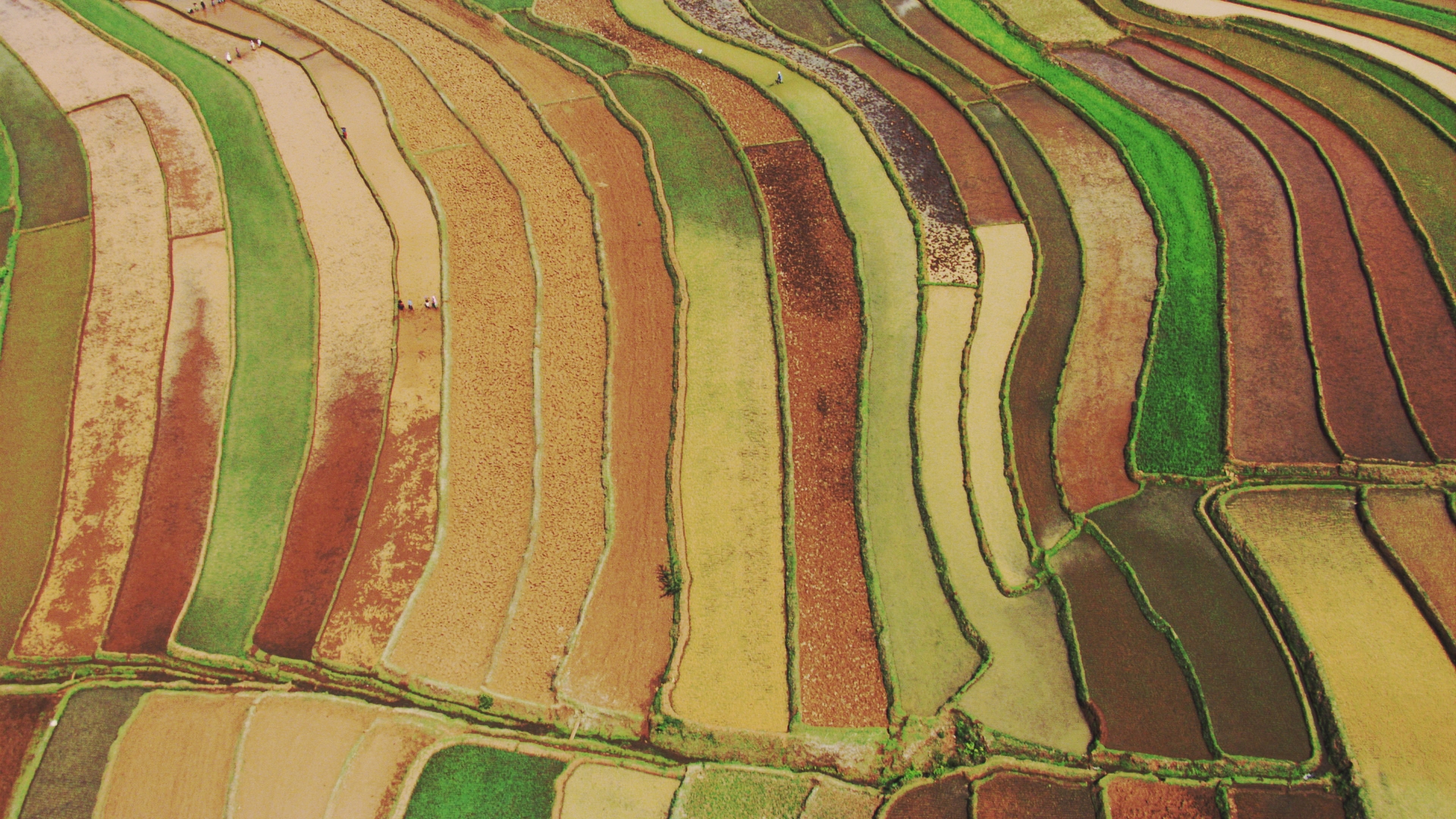
The terraced rice fields of Betafo — On the central highlands, around the town of Betafo and Antsirabe, Malagasy farmers have cultivated rice in terraces for centuries using ancestral techniques. Seen from the air, these stepped rice fields following every contour of the terrain are perhaps the most beautiful agricultural terraces in the world — a collective sculpting of nature shaped by generations of farmers.
Isalo National Park — In the south of the island, the sandstone massif of Isalo offers from the air a landscape of canyons, mesas and eroded rock formations of austere beauty — a "Malagasy Colorado" in ochre and red tones, crossed by green gorges and hidden waterfalls.
The Manambolo River — At sunset, the Manambolo River winds through its gorges between the limestone cliffs of the Tsingy — an aerial shot of rare poetry, where the raking light turns the water to gold and the cliffs to purple shadows.
Nos images de Madagascar