Kenya — Aerial footage of a land of contrasts
Mount Kenya, Lake Turkana, Lake Magadi, Dadaab refugee camps — rushes available for licensing
Kenya is a country of extreme contrasts — between its magnificent natural landscapes and the often painful human realities our cameras have documented. Our Kenya collection is one of the most singular in our African catalogue, covering subjects that few aerial cameras have approached : from the volcanoes of Lake Turkana to the vast refugee camps of Dadaab, through the abstract patterns of Lake Magadi and the flash floods of the northern rivers.
Mount Kenya — The second highest peak in Africa after Kilimanjaro, Mount Kenya rises to 5,199 metres above the equator. Seen from the air, its eroded volcanic silhouette, surrounded by mountain forests and high-altitude moorlands, offers a landscape of rare majesty on the African continent.
Lake Turkana — In the East African Rift, Lake Turkana — nicknamed the "Jade Sea" for the colour of its alkaline waters — is the world's largest desert lake. Our aerial footage of its volcanic shores, its islands and its intensely turquoise-green waters set against an arid landscape ranks among the finest in our African collection.
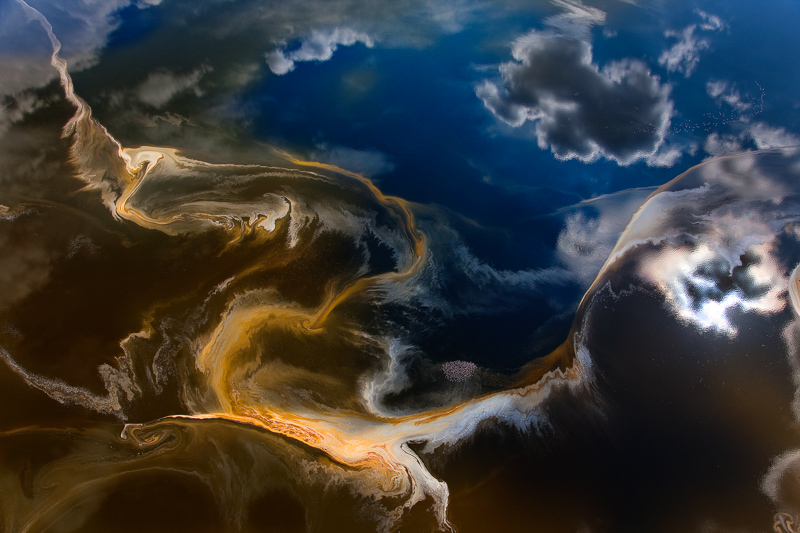
Lake Magadi — patterns and industry — In the Rift Valley, Lake Magadi is a soda lake almost entirely covered by a crust of trona — natural sodium carbonate — in shades of pink, white and ochre, crossed by channels of open water and dotted with flamingos. Seen from the air, its surface forms abstract compositions of hallucinatory beauty. On the shores of the lake, the soda processing plant of the Magadi Soda Company creates a striking industrial contrast with the natural environment.
Rivers in flood — Our footage also documents the flash floods of the rivers of northern Kenya, a seasonal phenomenon of spectacular violence seen from the air — torrents of ochre mud sweeping across desert plains, transforming dry riverbeds into raging rivers within hours.
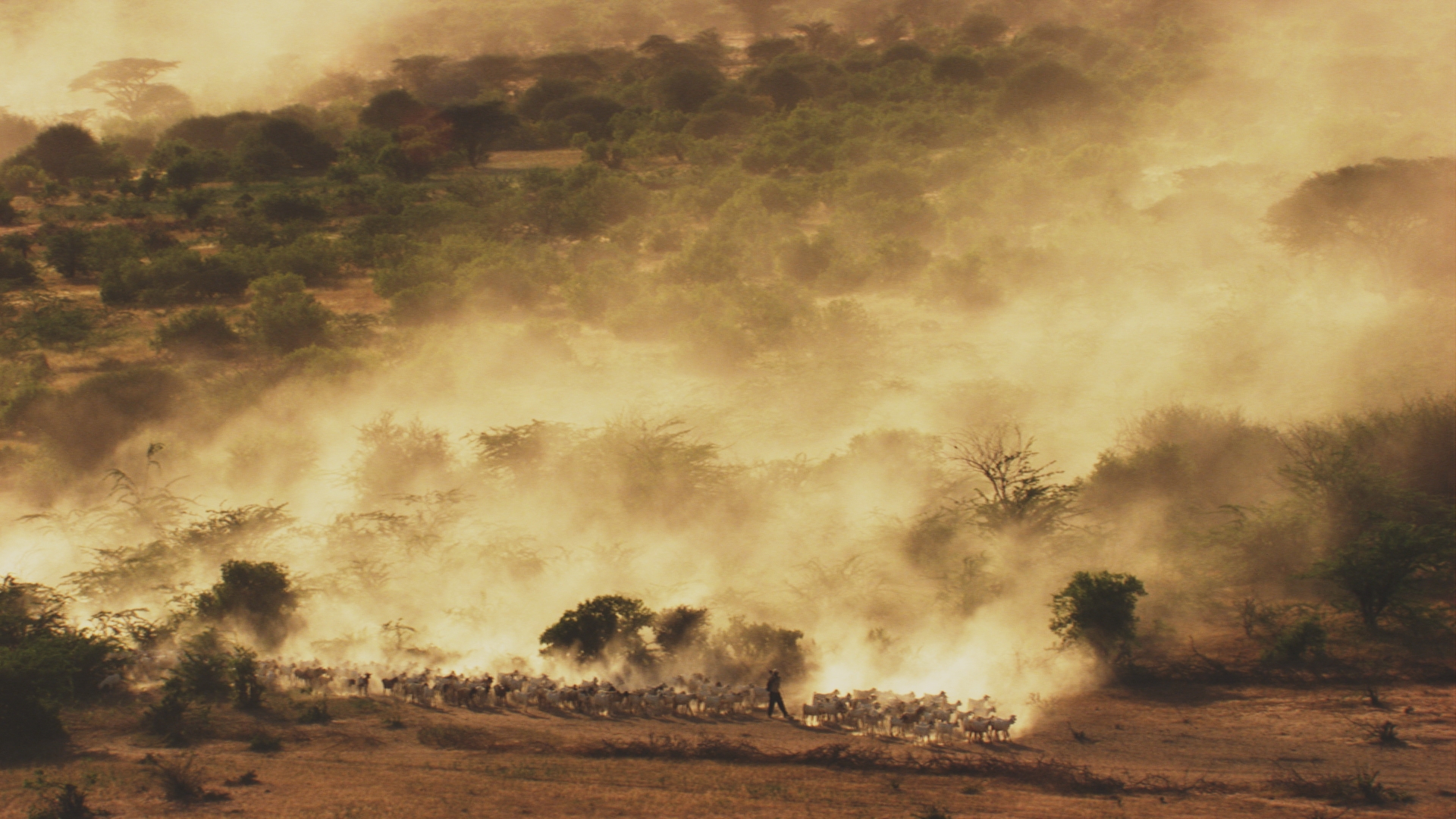
The Dadaab refugee camps — This is perhaps the most important and most rare part of our Kenya collection. The Dadaab camps, in Garissa County, about a hundred kilometres from the Somali border, form one of the largest refugee camp complexes in the world — at their peak, over 500,000 people lived there, fleeing civil war and famine in Somalia. Seen from the air, these camps reveal a reality that the ground does not allow one to grasp in its full scale : tens of thousands of canvas shelters and blue tarpaulins stretching as far as the eye can see across a semi-desert environment, surrounded by a zone of total deforestation — firewood having been harvested for kilometres around. Our footage includes the Hagadera camp and its infrastructure — schools, markets, activity zones — as well as the vast herds of goats grazing on the outskirts of the camps.
Farmers and villages — Beyond the crisis zones, our Kenya collection also documents ordinary rural life : farmers and small villages seen from above, transhumant herds, local markets and subsistence crops — an image of everyday Kenya far from the safari clichés.
This footage was shot using gyro-stabilised Cineflex / GSS systems mounted in helicopters, available in HD.
Les trois premiers camps de réfugiés de Dadaab ont été créés au début des années 1990. Les réfugiés de la guerre civile en Somalie se sont d’abord fixés à Ifo où le HCR (Haut Commissariat des Nations Unies pour les Réfugiés) a créé un camp en septembre 1991. Face à l’accroissement de la population d’Ifo, le HCR supervisa la création du camp de Hagadera, ouvert en mars 1992, et de Dagahaley, ouvert en juin 1992 Comme dans la plupart des camps de réfugiés en Afrique, les principaux problèmes immédiats sont la malnutrition, la santé, l'assainissement et le logement. La création des camps a été suivie très rapidement par la déforestation rapide de toute la région.
La sécurité dans la région a toujours été précaire. Les véhicules des organisations humanitaires sont souvent attaqués. Se déplacer la nuit est dangereux et un couvre-feu a été instauré.
Un problème récurrent est l’insécurité à laquelle les femmes et les enfants doivent faire face. Les possibilités d'emploi sont limitées. Les réfugiés de Dadaab sont principalement des nomades et des pasteurs qui ont tout perdu en fuyant la Somalie. La plupart ont laissé leurs troupeaux en Somalie ou les ont perdus en route. Les réfugiés n’ont pas l’autorisation de travailler en dehors des camps. Ceux qui possèdent du bétail (notamment des chameaux) ne peuvent le faire entrer dans le camp et le font garder à l’extérieur par des habitants des lieux.
On trouve aussi parmi les réfugiés quelques agriculteurs dont beaucoup sont originaires de la vallée de la Jubba, des fonctionnaires et des commerçants.
Nos images du Kenya